—
Fertilizer price swings are back on the radar for Michigan farmers after a spring run-up that some growers say tightened margins at the worst possible time, prompting renewed questions about whether global shocks, industry consolidation, or both are driving what they pay.
The debate comes as the Federal Trade Commission has opened an investigation into the fertilizer industry, and as farmers look ahead to fall applications and winter deliveries.
While some purchases for this growing season were already locked in, growers and farm groups say the next buying window will test whether prices stabilize or spike again.
John Delmotte, who farms about 1,200 acres at Country View Farms in Monroe County, said sourcing product has not been his problem.
“We have not had any issues with supply, at least in this part of the world,” Delmotte said. “The bigger issue is the price for the product.”
A farm economy focused on breakeven
Delmotte grows corn, soybeans and wheat alongside his family.
When asked about the state of the farm economy, he didn’t mince his words.
“It’s poor,” Delmotte said. “Many growers are really not even looking for profitability, they’re looking for breakeven.”
Fertilizer and seed are his two biggest costs, and he argued both industries have seen significant consolidation.
Nitrogen is key for corn, and the price moved quickly
The farmer said nitrogen is the largest fertilizer component for growing corn and one of the biggest cost drivers on his operation.
He managed to lock in urea and 28 percent nitrogen last summer for about $400 a ton, but saw periods this spring when prices moved to $600 or more.
“That just goes to show you that there was a very quick, very rapid increase in those costs,” he said.
Delmotte said when inputs climb faster than commodity prices, the math can turn negative.
“People will lose money growing a crop,” he said. “We work all year long and we find ourselves in a negative position at the end of the year where we’ve lost money doing the work.”
Is consolidation the real issue?
Geopolitical tensions may have been the spark for a spike in prices, but some farmers believe a lack of competition is what allows prices to jump.
“When we look at fertilizer suppliers, the manufacturers, the actual suppliers that provide those products to growers across the United States is literally countable on one hand,” Delmotte said.
In May, growers welcomed the announcement of the FTC investigating what’s behind the spike in fertilizer prices.
“It’s become very clear that there is monopolization and issues with our antitrust laws in that industry,” Delmotte said.
Michigan Farm Bureau points to a global market
Theresa Sisung with the Michigan Farm Bureau said fertilizer pricing reflects many moving parts, including global supply chains and conflict.
“There’s a lot of factors that go into fertilizer prices,” Sisung said. “It’s a global market.”
She said disruptions anywhere can shift demand and sourcing.
“You can’t nail it down and say this one thing caused the increase,” she said.
Sisung also said timing matters. Farmers need fertilizer to plant and maintain crops, even when the market is volatile.
“Unfortunately for farmers, they pay retail prices for most things, and then they sell at wholesale prices,” she said.
What about grocery prices
Sisung said consumers should not assume higher grocery prices translate directly into higher farm income.
“Unfortunately, the price that you pay at the grocery store isn’t the price that the farmer receives,” she said, noting transportation and other costs along the chain.
Delmotte said shoppers may not see an immediate price jump tied to fertilizer, but he believes long-term pressure will show up somewhere if farms cannot consistently cover rising costs.
“So near term, probably not going to see it,” he said. “Long term, buckle up.”
The cash commitment behind one tank
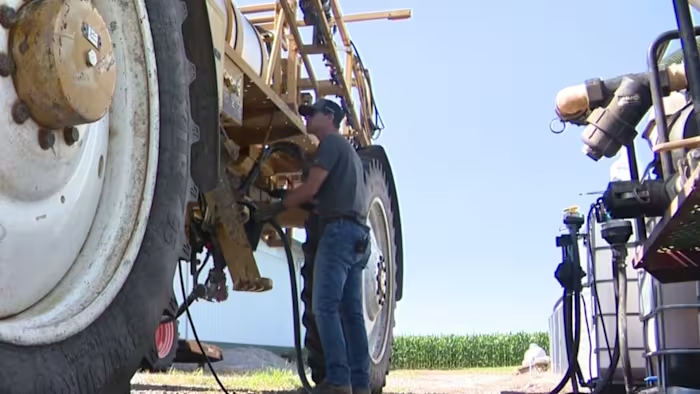
On Delmotte’s farm, liquid fertilizer is stored in containment tanks designed to prevent spills from contaminating soil.
“This one tank’s about, right now, about $55,000 full of fertilizer,” Delmotte said.
He said he recently pre-bought nitrogen for a future season with a deadline to pay the same day. He said some growers did not buy early, but he did not want to risk another sharp run-up after what he described as getting burned last year.
Mosaic responds
Mosaic, one of the country’s largest fertilizer producers, said global conditions shape the market and said it shares concerns about rising costs.
“Mosaic shares concerns about rising input costs because the success of farmers is closely tied to our own,” the company said in part. “As a producer of phosphate and potash crop nutrients, we operate in global markets shaped by raw material, energy, transportation, and geopolitical factors.”
In a separate portion of its statement, Mosaic said sulfur, which is used to produce phosphate fertilizer, has been harder to find in recent months.
Stress in the countryside
Sisung said financial strain is continuing across the farm sector.
“Unfortunately, we’re seeing a slight increase in farm bankruptcies,” she said. “There is more stress in the countryside for sure.”
She said many families still farm through tough cycles because it is multigenerational work and a mission to feed people, even when it is hard to make the numbers work.
What happens next
Sisung said there may be some fertilizer application in the fall, but she expects it will be winter before deliveries pick up for the next season. She said many farmers have already paid the costs for much of this growing season.
Delmotte said growers will keep watching whether prices track real supply conditions, or whether they move on headline shocks and a market he believes offers farmers too few alternatives.
Copyright 2026 by WDIV ClickOnDetroit – All rights reserved.