—
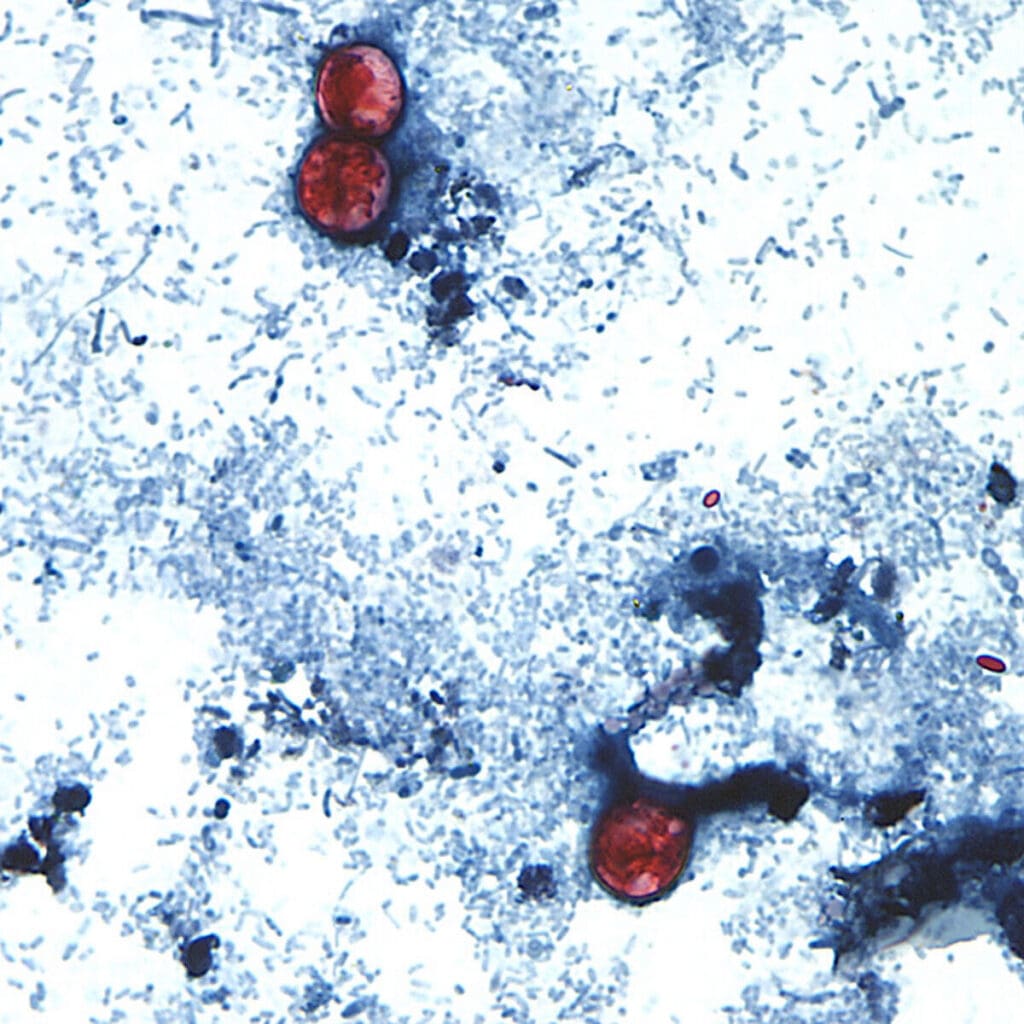
An image taken through a microscope shows Cyclospora cayetanensis oocysts. There are currently 4,013 cases of cyclosporiasis in Ohio, according to the Ohio Department of Health, with more than 90% of those cases reported after June 20.
Melanie Moser / CDC via AP
Two people have died from cyclosporiasis in Michigan, according to Michigan’s Health and Human Services Department, which is reporting the highest number of cyclosporiasis cases in the U.S., followed by the state of Ohio.
Both people “had significant underlying health conditions that may have been impacted by cyclosporiasis and dehydration,” according to state of Michigan.
The two people who died in Michigan also became sick prior to the voluntary recall of iceberg lettuce, according to the state. On July 17, Taylor Farms de Mexico, announced that they were voluntarily removing all iceberg lettuce sourced from central Mexico from the U.S. market, according to the U.S. Food and Drug Administration.
No additional information will be released on the two deaths in Michigan, according to Michigan’s Health and Human Services Department. The most recent number of cyclosporiasis cases in Michigan was 11,234. As of July 30, 193 of Michigan’s reported cases indicated they had been hospitalized.
Cyclosporiasis is a gastrointestinal illness caused by Cyclospora, a microscopic parasite that infects food that has come into contact with human feces, most commonly when produce is irrigated or washed with contaminated water. When ingested, the parasite causes intestinal illness marked by “frequent and sometimes explosive bowel movements,” according to the Centers for Disease Control and Prevention.
The most recent number of cases of cyclosporiasis in Ohio is 4,013, according to the Ohio Department of Health, the majority occurring after June 20. Locally, Montgomery County has 34 cases, Butler and Greene counties each have 13, Clark and Miami counties each have eight, and Warren County has seven.
Ohio has the second highest number of cases, according to the CDC’s surveillance of cyclosporiasis, which is also experiencing a lag in reporting data.
Since May 1, the CDC has received reports of 6,707 laboratory-confirmed cases of cyclosporiasis in the U.S. The CDC is aware of more than 11,500 additional cases that are not laboratory confirmed or require further investigation and analysis, such as ruling out international travel, the center stated, adding the majority of the cases the center still needs to confirm are in Michigan and Ohio.
The CDC is sending disease investigators to Ohio to provide support in tracing cyclosporiasis cases.
“CDC, at the request of the Ohio Department of Health, is deploying a number of its disease detectives to the state to assist with the cyclosporiasis investigation there,” a statement from the CDC reads.
The CDC team is expected to be Ohio for about three weeks.
“Deployed CDC staff will conduct interviews of persons who tested positive for Cyclospora to assess symptoms and collect exposure histories, analyze interview data to identify common exposure locations and foods, identify case clusters and coordinate with federal response teams on multi-state outbreak tracing efforts,” the CDC stated.
ODH requested the federal assistance for the Cyclospora investigation via an Epi-Aid. Epi-Aids are a longstanding CDC resource that provide assistance to state and local health departments during investigations.
“We are pleased to be hosting several Epidemic Intelligence Service (EIS) officers who are assisting with investigation efforts. CDC staff will assist with interviews of those who tested positive for Cyclospora and also analyze data to help with outbreak tracing efforts,” a statement from ODH says.