—
June 4, 2026, 6:05 a.m. ET
Fluffy white stuff is starting to float through the summer breeze, but you don’t have to worry — it’s not anouther round of snow.
Cottonwood trees are filling the air with seeds, creating a slow-moving spectacle — and some extra yard work.
From late May to mid- to late June, eastern cottonwood trees, native to Michigan, reproduce by dispersing small seeds attached to fluffy bunches of “cotton” into the air, known as, “wind-disseminated seeds,” according to Michigan State University Plant and Pest Diagnostics.
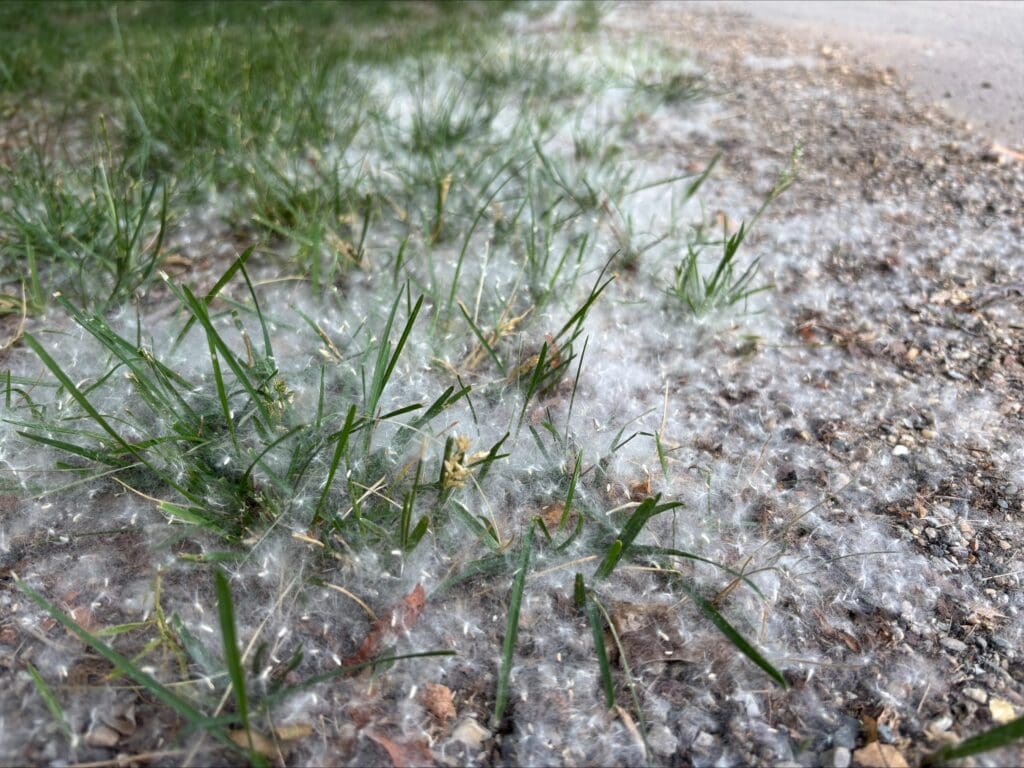
While the tree’s goal is for seeds to land in the soil, root and grow they oftentimes collect around buildings, atop grass and other spots, resembling piles of snow.
Cottonwood trees release their seeds for about two weeks, according to Purdue University Forestry and Natural Resources, but that’s plenty of time to create a mess.
Experts recommend removing clusters of seeds around your house and yard by using a rake, shop vacuum, leaf blower or a hose, the Seedsheets garden publication suggests. Seeds tend to get stuck on roofs, in gutters, along driveways, in garages and pools.
“Seeds usually flow easily downstream without the volume or mass to clog waterways. They can accumulate on air conditioner units or other filters but are easily cleaned off,” Purdue University said. “Cottonwood seeds are highly flammable, can pose a risk in drier climates, and should not be ignited to clean them up.”
Much of Michigan’s Upper Peninsula is facing “extreme” fire risk right now, and the entire state is in the high to very high risk categories.
The meteorological start to summer (June 1) in Michigan has been dry and relatively windy which are favorable conditions for seeds to fly around, though, once rain enters the forecast seeds will calm down.
Here’s more on eastern cottonwood tree seeds in Michigan.
What are those cotton balls floating past?
Michigan’s eastern cottonwood trees (populus deltoides) releases cotton-covered seeds into the air around the end of spring as a way to reproduce.
The species may grow 75-100 feet tall and favors moist soils, and are typically found across the southern Lower Peninsula, particularly around rivers and streams, and lakes.
Do all cottonwood trees produce ‘cotton’?
No, only females create the cottony mess.
Males produce reddish catkins, while females produce yellowish-green catkins, according to Treehugger.com. Both males and females produce green capsule-looking fruits, but only the females make cotton, while the males make pollen.
Why are cottonwood tree seeds an issue?
Eastern cottonwood tree seeds are not considered harmful to humans and are not an allergen, but they can carry pollen as they float around, Seedsheets said.
The fluffy seeds are considered wildfire fuel because they are flammable, so piles near grills, fire pits, or mulch should removed as soon as possible especially on dry and warm days.
The seeds also can become an issue for your grass, as piles could block sunlight or moisture. They also can sprout, leaving seedlings fighting for nutrients.
Contact Sarah Moore @ [email protected]