—
Michigan Supreme Court decision forces state regulators to revisit permits for Enbridge’s Line 5 tunnel project due to concerns over environmental risks.
Gov. Gretchen Whitmer’s administration calls on Enbridge to pursue alternatives to the tunnel project, citing threats to the Great Lakes and urging a planned transition to protect Michigan families and businesses.
Line 5 runs through the Straits of Mackinac, where tribal nations and environmental groups warn of potential crude oil spills, leading to continued uncertainty for Enbridge as state officials reevaluate permit decisions.
A Michigan Supreme Court decision is forcing state regulators to revisit permits for Enbridge’s Line 5 tunnel project after the justices said officials had not fully considered the environmental risks of extending the pipeline’s operation.
The review also reflects a sharper stance from Gov. Gretchen Whitmer’s administration following criticism from tribal nations and environmental advocates who said the project threatens the Great Lakes.
Here’s what to know
The Michigan Supreme Court threw out the Michigan Public Service Commission’s approval of the tunnel project, saying the state had not sufficiently examined possible environmental damage from keeping the pipeline running longer.
According to Michigan Advance, Whitmer’s office said the Michigan Department of Environment, Great Lakes and Energy has to assess what that ruling means for its own permit decisions on the tunnel.
Whitmer separately told Enbridge CEO Gregory Ebel that the tunnel should not be treated as the only option.
In her letter, she wrote, “I am calling on Enbridge to pursue an alternative to both the existing dual pipelines and the tunnel, and to begin that work now. Develop a planned, orderly transition that protects Michigan families and businesses and gets oil out of the Straits far sooner.
“That alternative may not preserve Enbridge’s current market share or be as profitable for your shareholders. But those are not reasons to expose the Great Lakes to another decade of unthinkable risk.”
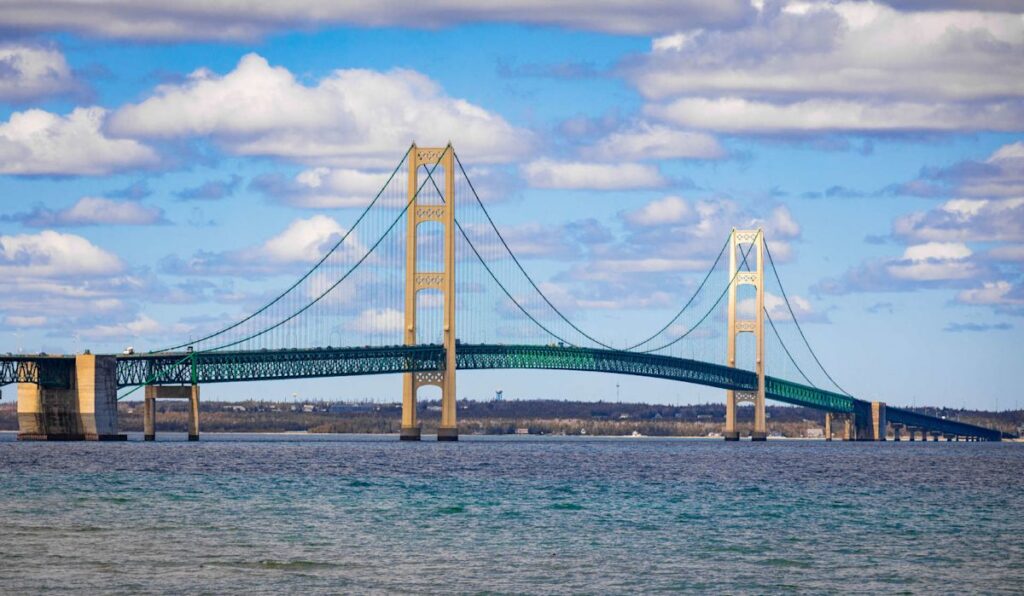
At the meeting point of Lakes Michigan and Huron, Line 5 runs roughly 4.5 miles through the Straits of Mackinac. Tribal nations and environmental groups have long warned that a rupture there could spill crude oil into the lakes.
Michigan Department of Environment, Great Lakes and Energy director Phil Roos said the agency already reviewed the tunnel’s environmental and cultural impacts, along with the alternatives required by law, but said the Supreme Court’s decision may require further analysis.
“Until all those legal questions are resolved, conditions in [the Department of Environment, Great Lakes and Energy] permit prevent construction of the tunnel entrance from moving forward,” Roos said.
More background
Enbridge’s tunnel proposal grew out of a 2018 incident in which an anchor hit the pipeline and dented it in three places. The company reached an agreement with the state during former Republican Gov. Rick Snyder’s administration to place a replacement section inside a utility tunnel.
Emily Woodcock, Michigan director for Clean Water Action, said the ruling means the state must consider Michigan’s environmental protection law together with the public trust doctrine when making environmental permitting decisions.
“That is so important, not just for the Line 5 fight, but for every single fight moving forward,” Woodcock said. “That is like a game changer for our work.”
For the Anishinaabe, the Straits of Mackinac are the place of creation. The Department of Environment, Great Lakes and Energy’s permit noted that the “project will have adverse effects on known historic and cultural resources, including their destruction and/or removal.”
What’s being done?
State officials are deciding what next steps fit the court’s ruling and Michigan law. That leaves Enbridge facing continued uncertainty even after it secured approval from the U.S. Army Corps of Engineers.
Enbridge spokesperson Ryan Duffy said the company is still pointing to its agreement with the state authorizing tunnel construction.
“Without years of litigation and political intervention, this project would be moving toward completion,” Duffy said.
Tribal leaders and advocates want Michigan to go beyond revisiting the permits and pursue alternatives that would remove oil transport risks from the Straits altogether.
David Gover of the Native American Rights Fund, who represents the Bay Mills Indian Community, said the permits should never have been issued and that time be taken to fully review the impacts on Tribal communities.
“The Straits of Mackinac are a sacred space, and should be protected from permanent destruction by oil pipelines running through the Straits,” he said.
“Our treaty rights are not an afterthought, and our voices should not only be heard when it is convenient,” said Bay Mills Indian Community president Whitney Gravelle. “The Straits are our homeland, not a corridor for a foreign oil company.”
Where can I learn more?
Michigan’s renewed scrutiny of Line 5 is part of a wider debate over how states handle the risks tied to fossil fuel infrastructure.
• In North Carolina, Transco faced environmental and public health danger claims as expansion moved ahead.
• In Montana, officials challenged young activists’ monumental win over state environmental policies.
• Nationwide, utilities keeping old coal plants alive are costing Americans hundreds of millions.
At stake is how much environmental, cultural, health, and economic risk governments are willing to accept to keep polluting, non-renewable infrastructure operating.
Get TCD’s free newsletters for easy tips, smart advice, and a chance to earn $5,000 toward home upgrades. To see more stories like this one, change your Google preferences here.