—
By Anna Barnes
The invasive elm zigzag sawfly has been confirmed in Michigan for the first time by the U.S. Department of Agriculture through genetic verification methods at the Smithsonian Institution.
The species was confirmed in Fort Gratiot in St. Clair County after an arborist submitted a report through the Midwest Invasive Species Information Network online reporting tool.
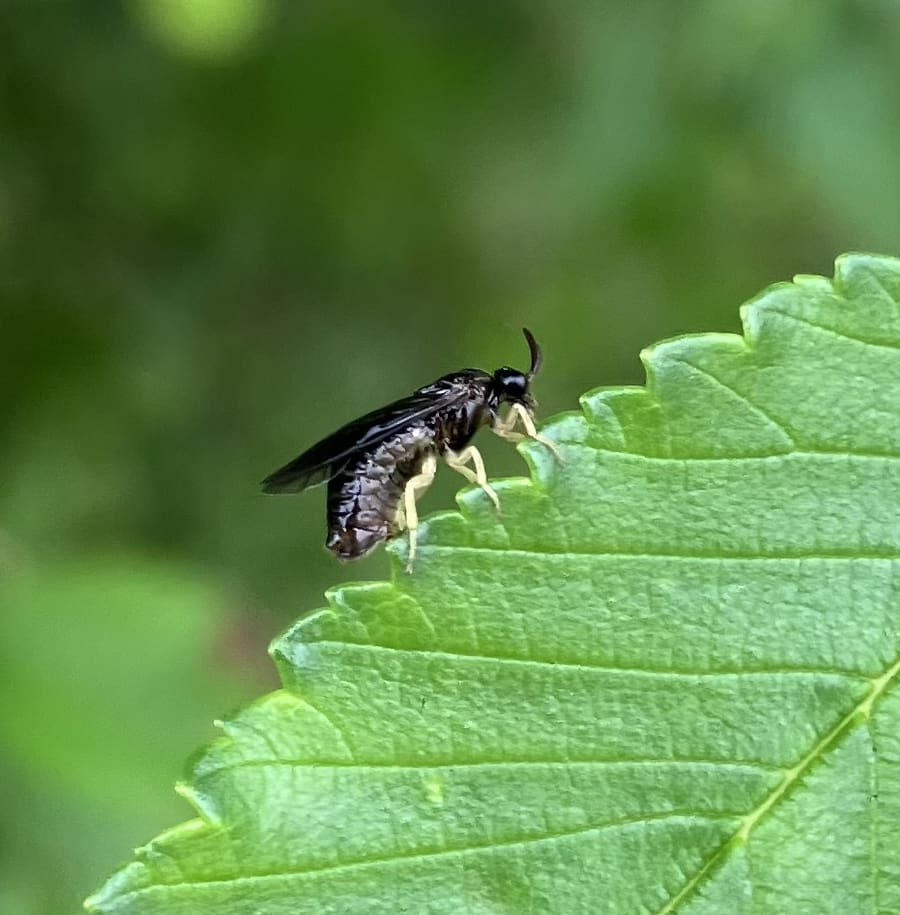
The elm zigzag sawfly is an invasive species that defoliates elms by eating zigzag patterns into their leaves. An adult looks like a small wasp, with a shiny black body and pale yellow legs and has the ability to fly.
Rob Miller, an invasive species prevention and response specialist with Michigan’s Department of Agriculture and Rural Development, said the species can spread far and fast.
“They can move pretty quickly,” he said. “The adults can travel long distances. Research has shown that they can travel anywhere from 28 to 56 miles.”
The species is native to Asia but has been present in Europe since 2003. In 2020, it made its way to Canada, then into 17 states over the next couple of years.
It feeds only on elm leaves. Healthy elms easily re-foliate, making the threat level of these sawflies low for Michigan’s forests. Homeowners can contact licensed arborists to evaluate and help treat their infested elm trees, Miller said.
The sawfly is easily identifiable as larvae, presenting as a light green color. Other identifiable features include a dark brown or black band on the back of their head and pea shaped markings above their second and third pairs of legs, he said.
While the zigzag feeding patterns may be the most obvious sign that damage can be attributed to these sawflies, once they inhabit an elm for long enough, more of the leaves are eaten, erasing that evidence, Miller said.
“Elms can handle that, they can handle defoliation pretty well actually because they will just set a second flush of foliage in midsummer,” Miller said. “They rarely sustain any serious long-term injury.”
While the threat level is low, Miller said reporting the invasive species is important so the state can keep track of where the sawfly is moving and how large the population is. You can report sightings of the Elm Zigzag Sawfly to MDARD or through the Midwest Invasive Species Information Network online reporting tool. Accompanying the report with photos is encouraged and can help verification of the species.
Anna Barnes is an environmental reporting intern through a partnership with the MSU Knight Center for Environmental Journalism, the Mott News Collaborative and Michigan Public. This story was produced for Michigan Public.