—
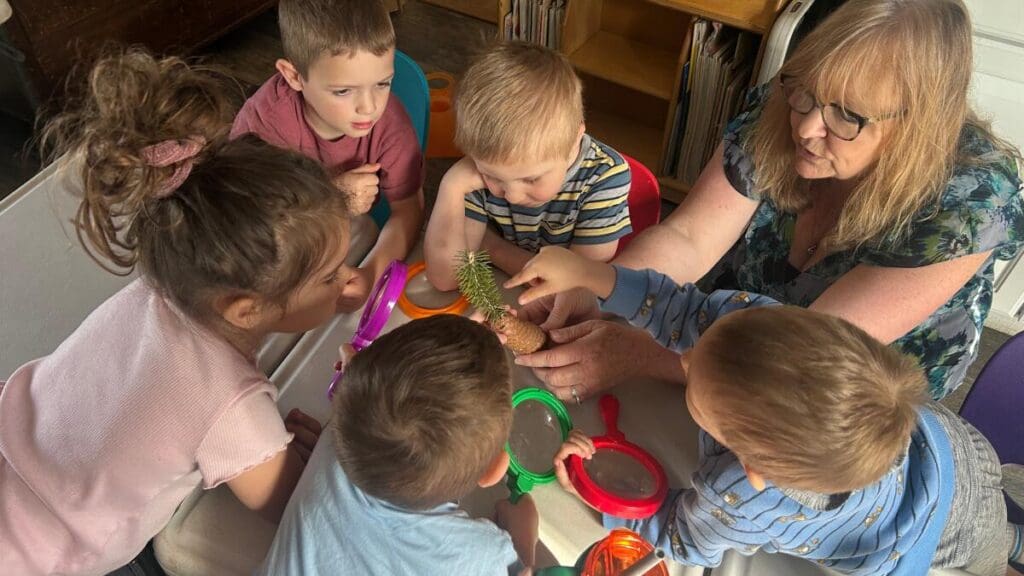
Around small tables and colorful magnifying glasses, Lori Legger teaches six young children about living and nonliving things. Her child-care center runs much like a traditional school: The students say the Pledge of Allegiance and there are plenty of books available.
But other aspects are different: There are hens and roosters outside, and Leggert’s youngest student is 18 months old.
Leggert is the owner and teacher of the Sky’s the Limit Family Childcare. Her business is participating in Michigan’s new pilot program to test no-cost pre-kindergarten in home-based child-care settings. One parent estimates she will save $2,600 this spring and summer.
“It benefits all the children in my care, not just the 4-year-olds,” said Leggert.
Michigan’s ‘Pre-K for all’ effort allows any 4-year-old to attend a no-cost pre-K. But until this pilot program, home care providers were not eligible to participate.
In total, the pilot program will support up to 75 to 80 children aged 3 or 4 to attend preschool, according to the Michigan Department of Lifelong Education, Advancement, and Potential. The $1.5-million program is funded through a federal grant and will run over the spring and summer with the potential to continue this coming school year. Participants can receive funds for coaching, curriculum, materials and assessments.
It’s an idea that early childhood advocates hope will catch on.
“Home-based providers are an untapped resource,” states a state policy document outlining the challenges and opportunities for the state to expand pre-K.
There were 3,344 group homes or family child-care sites across the state in fiscal year 2024, according to a report to lawmakers.
Deb Dupras, executive director of Community Coordinated Child Care Assn. of the Upper Peninsula, said it’s important that home providers are part of the conversation. Her group connects parents with child-care options and trains early child-care workers.
She said she hopes that at the end of the pilot program, students in the home settings perform at least as well on assessments as students taking pre-K in a child-care center or school.
Joan Blough, vice president at the Early Childhood Investment Corporation, a group that supports hubs of home providers, said it’s important to give families choice and options for their pre-K.
“It’s smaller, more intimate, you can have more individualized attention,” she said.
Michigan’s pre-K expansion
Michigan families can choose to enroll their 4-year-olds in free pre-K through the Great Start Readiness Program. These classes occur in schools, child-care centers and churches. Almost 55,000 students are enrolled across the state.
Until recently, it was only free for students from low-income families but now is available to any student as part of Gov. Gretchen Whitmer’s “pre-K for all” effort.
Michigan’s pre-K effort is ranked 17th in the country for access to 4-year-olds, according to new research from the National Institute for Early Education Research. The group also lists Michigan as one of a handful of states that meet all 10 benchmarks for quality.
Meanwhile, the state is funding other efforts to try to encourage more people to teach preschoolers. One apprenticeship program allows current paraprofessionals a chance to get a college degree and teaching certificate so they can lead early childhood classrooms.
Leggert does not have a college degree but has a child development associate credential and says she attends more than 20 hours a year of training. She said sometimes people think of home providers as babysitters, when they are “edu-carers.”
“I think sometimes hands-on and experience outweighs a degree,” she told Bridge Michigan.
Meeting people where they are
In Fowlerville, parent Taylor Provost’s 4-year-old son attends Leggert’s program. Her older son attended a Great Start Readiness Program at a public school when he was younger.
“All that free stuff, it sounds great, right,” Provost said. “But then when you think about quality child care, and you’re just comfortable, too, with where your kids are at, you kind of make that decision of ’OK, we’re going to just keep him there even if we have to pay.’”
Now that she can keep him at Leggert’s home at no cost, it’s a “no-brainer,” said Provost, who estimates she is saving $2,600.
Advocates say giving families choice and the option to keep their preschooler with siblings is good for families and the state. Home providers can offer more flexible hours too.
Katie Sloan, an assistant professor at Oakland University, said it’s smart to include home providers in the state’s pre-K efforts, especially as the state implements other changes to make pre-K for all a reality. The state now allows more students per teacher and allows programs to move from operating four days a week to five days.
“For some children, they benefit from being in a home-based setting where they’re not in a crowd of children and might have a lower ratio,” said Sloan.
This article was originally published by Bridge Michigan and distributed through a partnership with the Associated Press.