—
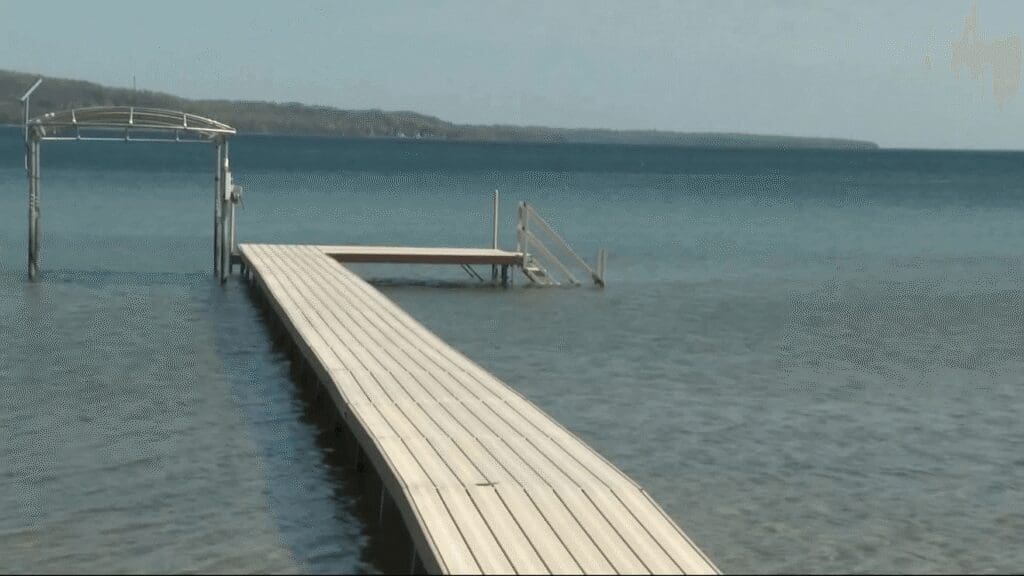
LEELANAU COUNTY, Mich., (WPBN/WGTU) — If you live or drive along the shorelines of the Great Lakes, you’ve probably seen docks and hoists going into the water. You also may have noticed earlier in the spring that water levels were low, but they’ve risen in recent weeks.
Water levels on the Great Lakes have always fluctuated, but especially in the last few years.
“Two years ago or so, the water went way down and for Docks and Hoist, there were times that there was, the docks were hardly in water, it was ankle deep and boats weren’t able to get on hoist and was a drastic issue,” said Ben Bakker, owner of Leelanau Dock and Hoist.
With the cold, snowy winter, docks are going in a little later than normal.
“This year we started about the 20th of April,” said Bakker. “We get them in all spring and Memorial Day weekends are the deadline, but this year we’re going to be pushed back beyond that.”
Inland Seas Education Association executive director Fred Sitkins said we saw near-record lake levels in 2024 and in 2025, they were significantly lower. This year, things are a little more normal.
“We witnessed the month of April as a record month dating all the way back to 109 years,” said Sitkins. “We saw a 13.4-inch increase in the Lake Michigan and here on water levels. That’s just tremendous. Lake Superior also rose to a significant level in April.
Currently, the lake levels on Lake Michigan and Lake Huron are just above the normal average of around 579 feet.
Lake Superior is also close to its normal level of 601 feet.
“The lakes were in a perfect position to receive this water,” said Sitkins. “We needed it. It brought them back up to levels and I like to caution, thinking about boy, what would have happened if this was 2024, when we were already battling with significant erosion and high-water levels. If we would have had a 13-inch increase there, that could have been devastating.”
Sitkins said that if we see an average summer in terms of rain or even slightly below average, we are in line for a great summer on the Great Lakes.