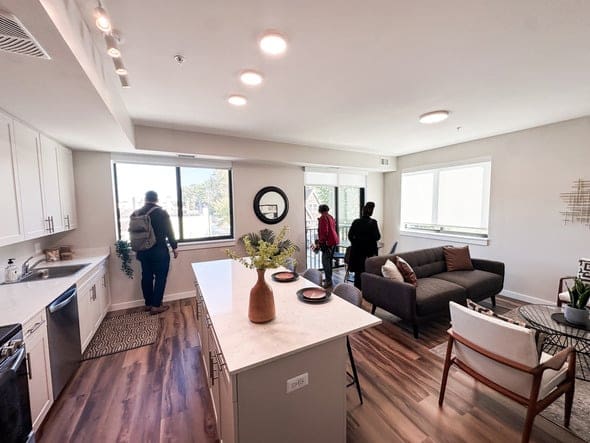
—
After investing more than $58 million and adding almost 1,000 units of affordable housing in the City of Detroit through the Detroit Housing for the Future Fund (DHFF), the impactful investment fund returns. Announced during the March 31 State of the City address, Mayor Mary Sheffield spoke about the Local Initiatives Support Coalition (LISC) and the second phase of this fund.
“Affordable housing is foundational to Detroit’s future,” Mayor Sheffield says. “As our city grows, we must ensure longtime residents and working families can continue to live and thrive here. We want to showcase the impressive impact that was delivered during the first round of investment and highlight the need for additional private investment for the Fund 2.0.”
Housing is a central part of Mayor Sheffield’s platform, and this DHFF 2.0 fund is one of the tools to protect affordability and foster stronger, stable neighborhoods. Bringing together private capital, public investment and community partners, the DHFF provides another solution to the complex housing crisis.
The first initial launch of the DHFF in 2020 helped to finance more than 936 units of affordable housing across 19 developments, investing more than $46 million with Detroit-based developers.
Rob Lockett is the executive director of Local Initiatives Support Coalition, or LISC Detroit, a community development financial institution (CDFI) and member of the Detroit CDFI Coalition. LISC Detroit also serves as the funds manager of DHFF. The CDFI is aimed to “invest in places and spaces for individuals and families to thrive.”
Rob Lockett is the executive director of LISC. Courtesy photo.
“Our main vehicle as a CDFI is to do that through investing in real estate development at the local level,” Lockett says. “We also have program partners that we execute community-based programs through that are designed to increase the quality of life for individuals and families, and also help individuals achieve economic development through access to capital across our footprint.”
THE DHFF Fund is designed to provide below-market rate capital to developers all across the city of Detroit.
“This fund ensures that we have capital availability for projects that happen in areas where in some cases, otherwise would not be able to see investment,” Lockett says. “We focus at the neighborhood level, and do that using our local development and contractor ecosystem to execute that.”
Keegan Mahoney is the program director for the City of Detroit Housing and Revitalization Department. He remembers when the DHFF became a concept around 2018 when his department was only a few years old.
Keegan Mahoney is the program director for the City of Detroit’s Housing and Revitalization Department. Courtesy photo.
“This was a time when we were just coming out of a period of a very challenging housing market, coming out of The Great Recession, and bankruptcy,” he says. “There was a lot of foresight to see some of the housing price pressures that we’re seeing across the country and region, and the continued revitalization of Detroit neighborhoods — that affordable housing was something that we were going to need to focus on with much more intensity.”
Mahoney says that although there are many public tools available for affordable housing investments and preservation, these tools often have federal requirements and a lot of rules attached.
“I knew that we needed another tool in the toolbox to support that type of development, and to provide a pathway for projects that weren’t a good fit for the public tools — but still needed similar flexibility in terms of the financing requirements to make those projects work. The concept was to partner with a CDFI, Detroit LISC, in particular to come up with a new tool that could bring private contributions into the affordable housing mix. There wasn’t a really clear vehicle to do that at that point.”
However, one thing that is clear is the need, says Mahoney.
“We know that Detroiters are at a very high percentage for cost burdens when it comes to housing, often spending more than 30 to 50 percent of their income on housing costs,” he says. “Bringing more subsidized affordable housing helps to alleviate that really significant financial challenge many Detroit households are facing.”
Since the tool was effective in financing affordable housing, Mahoney considered it an easy decision to keep the funds going.
“The adaptability of this fund is really the point here,” he says. “The financing environment is always changing, interest rates and construction costs have gone up, so it’s really important that this tool meets the ever-changing needs of developers. That’s where a CDFI becomes a really valuable partner because they’re able to be nimble in a way that is necessary to be successful.”
Rod Hardamon is the CEO and founder of URGE Group, a real estate advisory, development and investment firm in Detroit.
Rod Hardamon is the CEO and founder of URGE Group, and a past recipient of the first phase of the Detroit Housing for the Future Fund. Courtesy photo.
“In addition to our advisory work, we’re actually a principal developer ourselves and have invested $70 million into the City of Detroit through adaptive reuse, mixed use, and new construction projects,” Hardamon says.
URGE Group is working as an imaginative builder on developing the $36 million Higginbotham Art Residences, featuring 100 affordable housing units as well as the OSI Art Apartments at West End, a $14.5 million Grand River Corridor place-based transformative redevelopment project.
“We also run an investment platform, Ebiara, where we actually invest capital into emerging development firms to help them grow in scale,” Hardamon says. “To date, we’ve stimulated approximately $240 million in development activity in the City of Detroit, bringing URGE’s collective impact to about $500 million.”
Hardamon brings his experience working on Wall Street back to his hometown of Detroit and is passionate about sustainable impact and systemic change.
He’s one of the original recipients of the DHFF 1.0, with the OSI Art Apartments.
“They helped provide mezzanine capital for us to complete our capital stack for our new construction that has 100% affordable, attainable units in the project that we’re delivering that will be open next month,” Hardamon says.
The second go-around of the DHFF allows there to be patient capital and supportive capital to support some of these neighborhood developments that require a little extra time and patience to be executed,” he says. “I think it’s a wonderful tool to help support that.”
Today, the user, developer and former client is also on a local advisory board for LISC Detroit too — bringing a lot of perspective to his roles. He has seen a recent retention of previously-utilized tools and knows the need for tools like the DHFF that can bridge those gaps. He is aware of the benefits of working with CDFIs who have a true local market presence and an anchor on the ground in the communities they support.
“That usually leads to more affordable housing and projects that get to the finish line, but also opens up the aperture of the type of developers that get to participate in the process. Sometimes, the developers in these deals may not always represent the cities, but working with CDFIs, it helps make sure developers look like and represent the broader parts of Detroit. This is super critical to making the broader city feel seen and included in the future of the city.”
Working alongside LISC Detroit’s mission-aligned drive helps create trust and understanding of the unique neighborhood needs.
LISC Detroit has deployed over $455 million in grants, loans and program investments, leveraging more than $1.5 billion to support affordable housing development and preservation, small business growth and workforce development for Detroiters since 1990.
Having those deeply-rooted relationships and a successful track record allow the launch of the DHFF to happen quickly.
Philanthropic and corporate partners were quick to invest, too. DHFF Phase 2 has already secured early commitments with $1 million from founding investor Flagstar Bank, $1 million from a new funder, Ally Financial Inc., and $10 million in support from The Kresge Foundation.
“The DHFF became the vehicle where there were corporate or philanthropic partners who wanted to invest in affordable housing, and they were able to do that through this fund,” Mahoney says.
Lockett says Phase 1 was instrumental in addressing the housing crisis, with impactful investments like The Ribbon, Merrill Place, and 8330 on the River.
The Ribbon is a development in East Warren tha