—
Votebeat is a nonprofit news organization reporting on voting access and election administration across the U.S. Sign up for Votebeat Michigan’s free newsletter here.
This November’s election will determine many things, but one of the most important is who will oversee the 2028 presidential election in Michigan.
In just a few weeks, Michigan voters will decide who will serve as their next secretary of state after eight years of Democrat Jocelyn Benson.
Her replacement will have big shoes to fill — the secretary of state is the state’s top election official, as well as the person in charge of making sure Michiganders have driver’s licenses, license plates, and more. It is the third-highest office in state government.
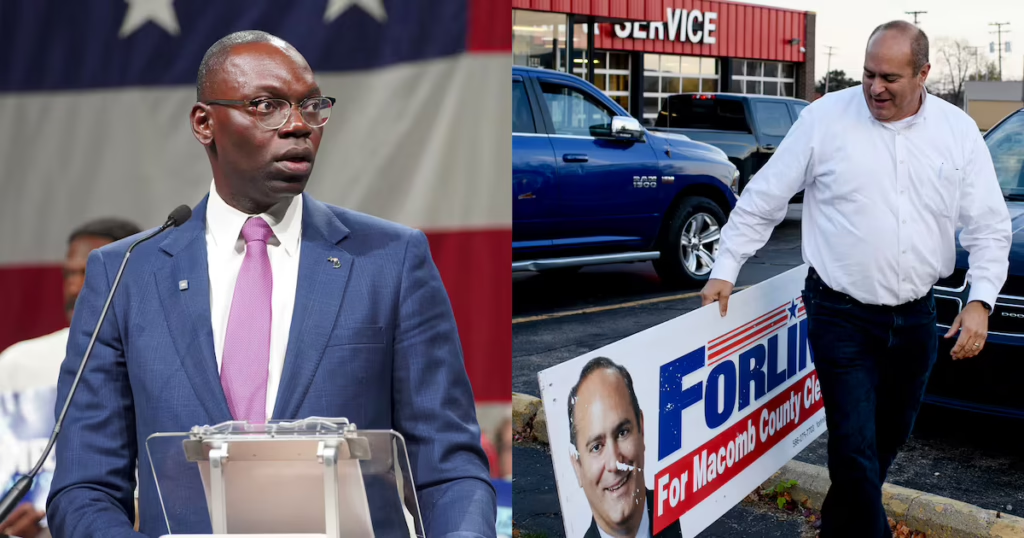
The two main candidates, Republican Anthony Forlini and Democrat Garlin Gilchrist, have both emphasized a need for better transparency in the office and improved vehicle services. Beyond that, they have very different plans for what they hope to accomplish if they take office.
Election news, Michigan made.
Get the latest on-the-ground reporting about voting in your community. Sign up for Hayley Harding’s newsletter, delivered twice a month.
Forlini, currently the Macomb County clerk, stresses that he wants the state to have cleaner voter rolls and better transparency. Gilchrist, the state’s lieutenant governor, wants to protect elections from overreach on the part of the federal government.
Votebeat sat down with both candidates ahead of their debate in Ann Arbor on Oct. 8 to glean their positions on the many issues facing Michigan elections. If you’re interested in hearing more from the candidates, you can stream the debate live on Thursday night at 6:30 p.m. Eastern.
Would secretary of state candidates give the Trump administration Michigan’s voter roll?
The next secretary of state is likely to inherit a year-long legal battle with the U.S. Department of Justice. Last year, the department asked Michigan — and every other state in the country — for lists of their registered voters, including voters’ personal information. However, after much back and forth, Michigan turned over only a redacted version of its voter roll.
The Trump administration wanted more, however, and sued Michigan for access to the unredacted roll. A district court dismissed the case in February, as did an appeals court in June. However, it’s possible the case could ultimately end up before the U.S. Supreme Court.
Gilchrist was clear: As secretary of state, he would absolutely not turn over the unredacted voter roll.
“When people give their data, their private information, to the government, they expect us to protect it, not fork it over to the president for his priorities,” Gilchrist said.
Forlini would not give a strict yes-or-no answer about turning over the voter roll, even when pushed for one. Instead, he said he sees clean voter rolls as a mutual goal of his and the federal government, regardless of who is in the White House.
“If Joe Biden were to call me to say, ‘Hey, we want to make sure the voting rolls are clean. Can we work together?’ I would say yes,” Forlini said.
He said he had “nothing to hide” and would want to work together with the federal government to find noncitizens on the voter rolls.
Michigan’s previous efforts to reach a mutually agreeable solution with the federal government eventually fell apart, but Forlini insisted that he was “the boss” and would be able to bring the department to the table.
States were previously unable to collaborate with the feds “because everyone’s got their head up their ass,” he said. “Quote me on that.”
Both Forlini and Gilchrist want to improve campaign finance reporting
Both candidates agreed that the state’s often-glitchy campaign finance platform, known as the Michigan Transparency Network or MiTN, needs a major revamp.
Forlini pointed to his efforts in Macomb County to modernize campaign finance reporting. For instance, bringing filings online freed up time for his staff to do other work, he said.
He also wants to see improvements to oversight and the disclosures candidates turn in. He said campaigns need to stop making errors where candidates leave out critical information about donors.
“I’m not going to allow that kind of stuff to happen anymore,” Forlini said. “We got to get our arms around it.”
Gilchrist said he wanted to use his background as a computer engineer to improve MiTN. He’s introduced a plan called “Stand TALL,” a play on his 6′ 8″ height, to address concerns about campaign finance. Each letter stands for a different topic — transparency, accountability, limits, and looking forward, according to his campaign literature.
Secretaries of state cannot write laws, but they can influence legislation, and Gilchrist wants to see dark money donors disclosed before an election and to push for “real-time enforcement” when campaign finance violations happen. Those would be his goals for the first year in office, he said.
“It’s hard for us to deal with dirty and dark money if we can’t see it,” he said. “I want to clean that up. Transparency starts with making sure we can fix that system and have a system that works for people and is easy to use, easy to navigate, and easy to understand.”
Forlini and Gilchrist want to improve election transparency in different ways
Both Forlini and Gilchrist say they want elections to be more transparent. Both want to see more collaboration among local clerks, who do the bulk of the work of running elections in Michigan. Both want to improve communication and build stronger relationships between the Department of State and local officials.
From there, though, their definitions of transparency diverge.
Forlini has been at the front of an effort to demystify elections for ordinary voters. Under his watch, Macomb County introduced an online tool called Ballot Verifier, which posts pictures of every ballot cast for people to view after an election.
He, like many Republicans, wants to change how election records are retained. He alluded to a recent lawsuit filed against Benson over how long certain records should be stored after an election, but he said he would like more data, such as that from electronic pollbooks, to be retained with its chain of custody intact for those who may have questions later.
“I don’t care if you’re a Democrat or a Republican — people are always questioning elections and the outcomes,” Forlini said. “The only way you can end it is through transparency while keeping the confidentiality of people. But you still need to be able to see the process all the way through.”
Gilchrist, meanwhile, said the work starts before an election is conducted. He wants to respond to “conspiracy theorists,” who he said often prey on a lack of knowledge about how election processes work.
To fix that, he suggests introducing “compelling and creative” ways to educate voters on how Michigan elections work, akin to Schoolhouse Rock videos.
“I think people not having clear insight and transparent understanding of that process is what enables the liars and conspiracy theorists and bad actors … to put their lies and misinformation into the world and let it fester,” he said.
Both candidates want better service at state offices
Gilchrist and Forlini would both like to see improvements at the offices where people get their driver’s licenses, car tags, and more.
Gilchrist called them “the front door to Michigan.”
“It’s an office that almost every Michigander has to deal with, so we need to make sure that it sees you, it respects you, respects your time, and treats you like a full human being,” he added.
He wants to see an option for walk-in visits at the Secretary of State Office alongside the appointment system that has been in place for several years. Customers can walk into an office now, but there is no guarantee they’ll be able to get service that day.
Gilchrist also wants to expand the number of stores that the self-service kiosks appear in and expand the mobile secretary of state units, which bring motor vehicle services directly to residents on college campuses or in communities where accessing an office directly may be difficult.
Forlini had similar ideas, including reviewing office processes and cross-training staff. Phones should be answered more reliably, he said, and walk-in access should be available.
It’s work he has already done in his roles in Macomb County, he said, both as clerk and at the county’s public works department.
“You look at processes and you see how you can reduce the amount of time people take at the counter,” he said.
Improvements will take time, Forlini said, but will serve customers well.
Why should Forlini or Gilchrist be elected secretary of state?
Votebeat gave both candidates an opportunity t